
Today started pretty badly. The plan was to use the day photographing some of the birds found in southern Arizona. I headed onto the trails and saw a pair of gorgeous Vermillion Flycatchers. After about an hour all I had was a few so-so photos of the female. Then I moved on to a nice big open field with several Cassin’s Kingbirds. From the other side of the field they flew away up into the trees. Patiently waiting didn’t help either. It wasn’t just these birds – it seemed like wherever I went all the birds wanted nothing to do with me. I felt like I must be doing something dreadfully wrong or else that today I should just give up. I headed onto a trail that followed a stream and even the sparrows would have nothing to do with me. Just when I was going to turn around and make my way back out, my luck turned and boy did it change. Right in front of me was the holy grail of Arizona birds – the Elegant Trogon. This is a tropical bird that belongs in the tropics of central america but ventures into just this one tiny patch of southern Arizona. I had acutally run into some birders the night before who were looking for this bird as it had been heard calling nearby but we had no luck with it and here it was right before me!
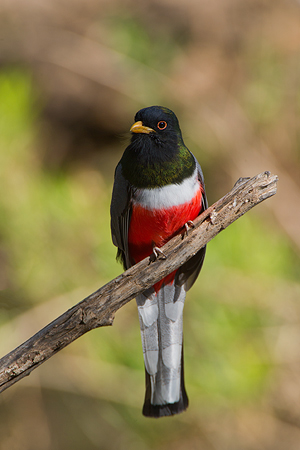
Elegant Trogon
Considering my luck earlier and that this was a bird that I had dreamed of seeing, I was extremely cautious and circled at quite a distance around to approach it from a direction where the light would be good. I was in complete disbelief when the bird flew right at me and landed half the distance away. In an attempt to set it at ease, I moved back further and it came again a few minutes later. This kept up for almost two hours as I realized what it was doing. It was hunting the insects along the river and working its way upstream. It would up a little bit and sit and watch for insects before repeating its pattern. It had absolutely no fear of me and at one point landed less than a foot from my shouder. It was a joy to photograph and an amazing beauty. I was able to hear its vocalizations, see it catch some large neuropterans and moths, and watched it fly numerous times through the latter half of the morning – not mention take many photographs with different compositions, poses, and backgrounds. Usually you get just a few seconds where you can photograph a bird and here I had many opportunities – several times it was too close to photograph. In the end, I finally said goodbye and watched it continue its short flights upstream as the ground cover became impossibly thick to walk through. What an end to the morning!
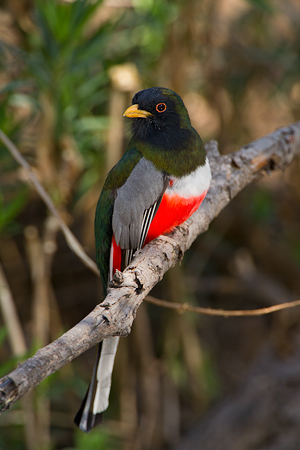
Elegant Trogon
It’s near impossible to top a morning like I had, so for the afternoon I would just be happy with getting an animal in front of the lens. So I returned to the location where I had scouted yesterday and decided to slowly work whatever was around. I wasn’t able to get a lens on the numerous sparrows in the scrub, but I found what I presume was the same Say’s Phoebe that was down by the water the day before. It was nearly as cooperative as the trogon had been. It was in fantastic light and in a spot where it was easy to isolate it against a clean distant background. Flycatchers have a very distinctive feeding behavior. They’ll launch off of a perch fly a loop in the air catching insects in flight and then land again on a perch. This Say’s Phoebe was having a field day hunting the insects near the water.
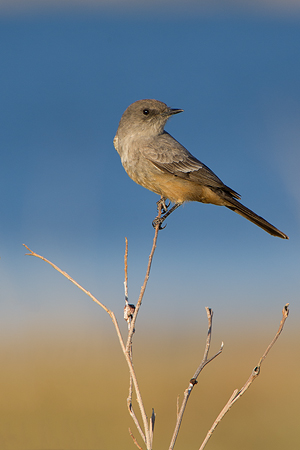
Say's Phoebe
At first I was just concentrating on getting some portraits of this cooperative bird. Then I started to get a little bit smarter. Its feeding behavior made it highly predictable. It used the same two perches over and over. The wind was in a good direction as well. That meant that I had a good chance to get some flight photos of this bird. Sure enough, the conditions were definitely right for it. If only I had realized this earlier in the afternoon! The light began to fade as I realized how to make the technique work best for this kind of flight shot. I did get a couple flight shots today and I now knew how to handle the situation in the future. Today was a great day and I felt like I had made two new feathered friends – or at least two birds who wouldn’t fly away as soon as they saw me!
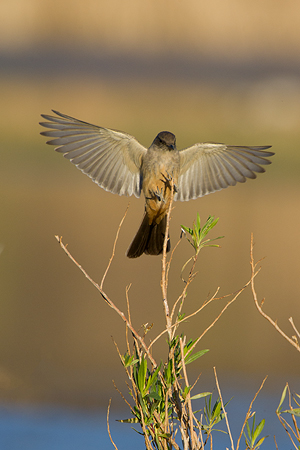
Say's Phoebe
Arizona is a big, big state. There were several places I was planning to visit in southern Arizona and although they were ‘close’ to each other, that means a few hundred miles of driving. So after waking up, I stopped by the Tucson Mountains on the way out of the Saguaro NP vicinity. The light on the mountains as the sun came up was great. At first I was alone, but a couple of other photographers came by as the light streamed onto the mountains. I worked the cacti and some HDR photos like this one a bit before heading back into the car for the drive south.
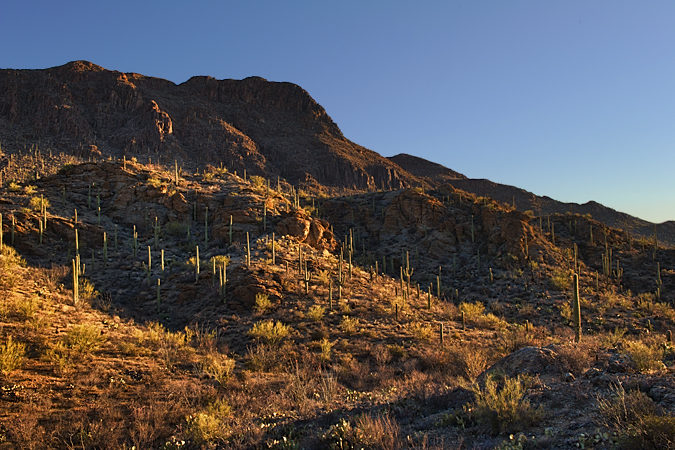
Tucson Mountains at dawn
So I headed south close to the Mexico border. The locations I was headed to I knew practically nothing about. My plans were flexible though, so if it was a let-down, I could always head back up to Saguaro. I was staying south of Patagonia, and headed out to a nature reserve next to the state park where I was pitching my tent. You couldn’t help by notice the lizards – they were everywhere! Quite a few kinds too, like this Tree Lizard. In addition, there were a few birds including a very cooperative Say’s Phoebe. The light was still pretty harsh and I made some mental notes of what was around before scouting out some other spots.
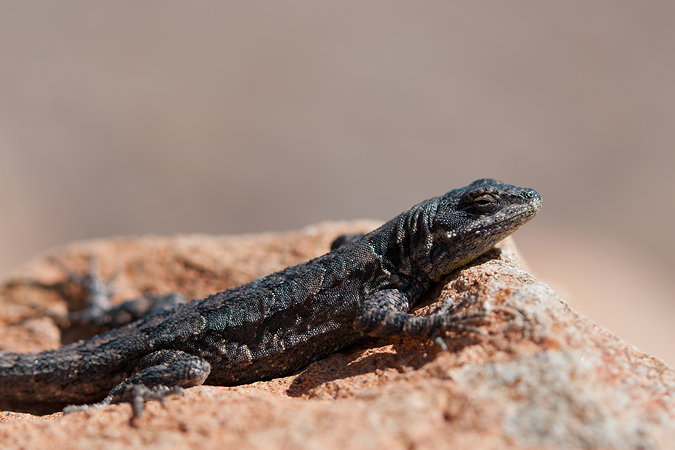
Tree Lizard
Being near Patagonia, it is impossible not to go to one of the most famous hummingbird spots in the world. Although the Paton’s have passed away, their house is still open to the public for watching the hummingbirds which frequent the feeders just a few feet from where you sit. I had heard of this place several times even up in Michigan and it certainly lived up to its reputation. At pretty much all times there were at least a few humminbirds darting around and feeding. Over the afternoon I saw about a dozen different species – a far cry the one species that you usually see in the eastern United States. I had a very pleasurable time sitting and watching the birds, but while the watching is great it’s not best location for photography. Personally, I don’t care for images of birds on feeders and most of the natural perches around the property weren’t great for photography. That said, if you ever find yourself in the area, you definitely must visit this place – the number and variety of hummingbirds that fly in front of you while you sit in comfort is unmatchable in the US. There are quite a few other birds that visit the property as well.
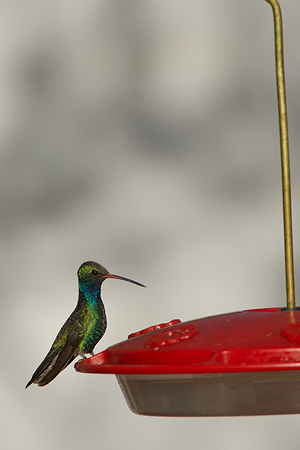
Broad-billed Hummingbird
As the sun started to go down it was time to head back to camp. The land nearby was quite different from that in the Tucson area. The Sonoran Desert was replaced by these rolling hills which we govered with amber grass. On both the west and east sides a distant mountain range enclosed the land. By now, I was pretty sure that this part of Arizona was going to be good for photography and my next few days would be well spent in the area.
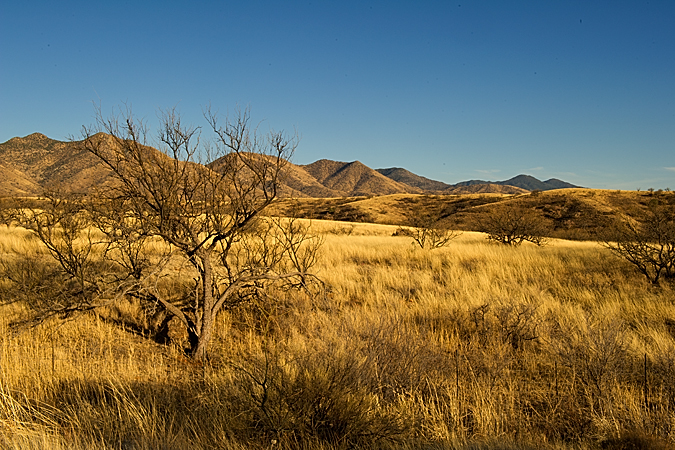
Amber Fields around Patagonia State Park
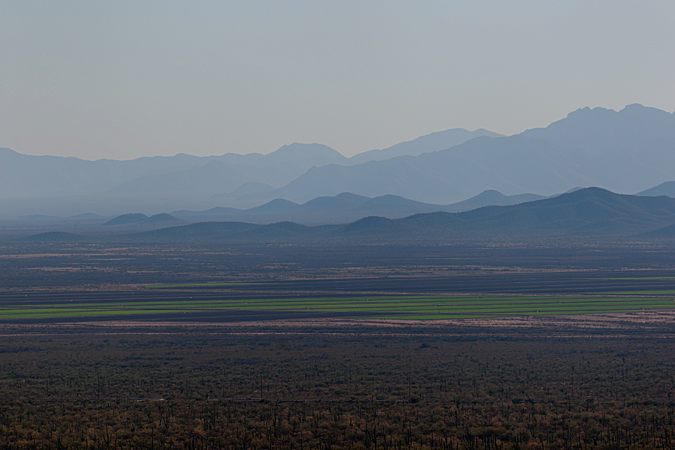
Mountains Shrouded in Fog
It’s easy to have preconceptions about what you want to photograph. Planning is great and leads to the best photos. But you can’t force an idea if it won’t work. I wanted to focus exclusively on landscape photos in Arizona and wildlife was supposed to be an afterthought. But the wildflowers weren’t blooming and there wasn’t a cloud in the sky (which makes for a very boring sky). If you see an opportunity, you have to go for it – whether it’s something cool you notice or fantastic light. Maybe it won’t work out, but it has a better chance than forcing something that’s not there. The early fog (or haze) over some distant mountains had my hopes up that there might be some good landscape potential today.
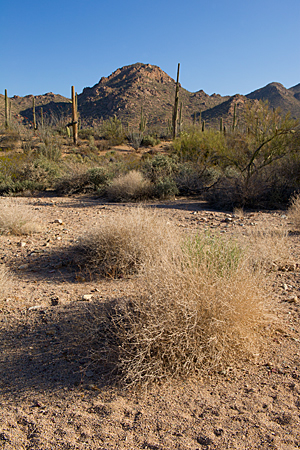
Saguaro National Park
By the time the sun emerged, any hint of moisture in the sky was gone. When the sky is dull and interesting, I prefer to minimize the amount of sky in any photos. Most of the vegetation was still looking a bit dead, but you can still find a few interesting subjects. The pattern in these clumps drew my eye.
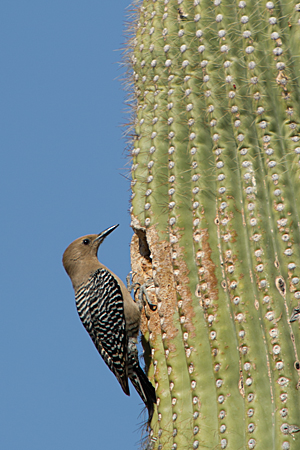
Gila Woodpecker
The last couple of days I had noticed that around my campground there were quite a few birds. The light is pretty harsh in the desert, but the light-colored sand reflects a lot of light up helping to soften it a bit. There were a pair of Gila Woodpeckers that were occupying a nest in a big tall saguaro right in front of the campground office.
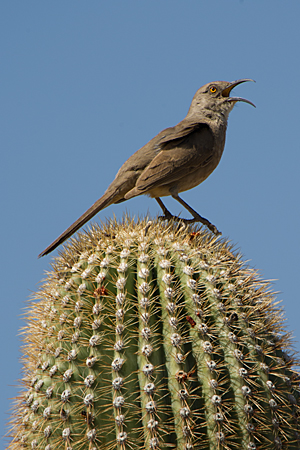
Curve-billed Thrasher
Curve-billed Thrashers were also pretty numerous around the campground. There was no way I could pass up one when it started calling from atop a cactus right in front of me. What a crazy beak these birds have.
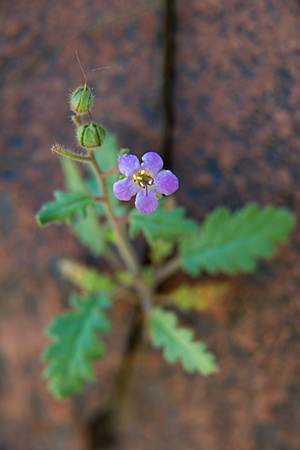
Flower in Saguaro NP
I was still on a quest for that saguaro silhouette image. I had another location scouted out and began hiking out there around 2 pm. I sat out the side of this hill waiting for the light to improve and make the silhouette possible. While I was waiting I found a tiny flower that had managed to flower in the shade behind the only large boulder in the area.
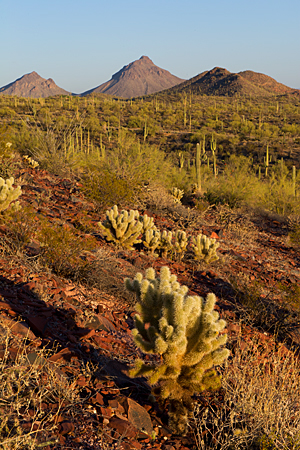
Saguaro National Park
The light became pretty nice and the cholla cacti combined with the rusty tones of some of the rocks created a foreground that captured my interest. It was my last day in Saguaro National Park and I had really enjoyed my day. As the sun went down, I took a few silhouette images, but it never yielded the vision that I had in mind. I was left with a newfound respect for how difficult it could be to find the elements positioned together corrected for such a shot. I didn’t really need extra encouragement, but it certainly gives me a reason to come back to Saguaro National Park in the future.
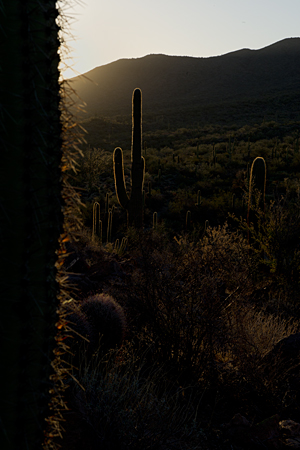
Backlit Saguaros
I started out the day chasing the light in Saguaro National Park. I love backlit cacti and I noticed that there are some great opportunities for these kind of images at Saguaro NP. The shapes of the saguaro are so distinctive that just a hint of their outline is enough to suggest the cacti.
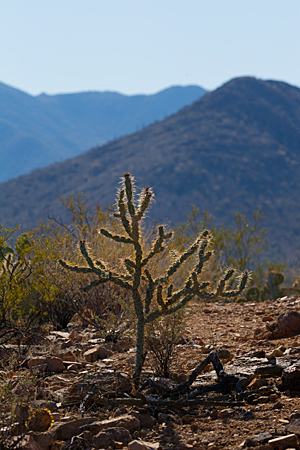
Cactus and Tucson Mountains
There are many different kinds of cacti in Saguaro National Park besides the saguaro. I found this one on a ridgeline. The way the Tucson mountains layered behind it made the image work for me. Normally most images I take like this would have a large depth of field, but here I wanted just the colors and the vaguest hint of the texture of the distant mountains so I opted for a shallow depth of field.
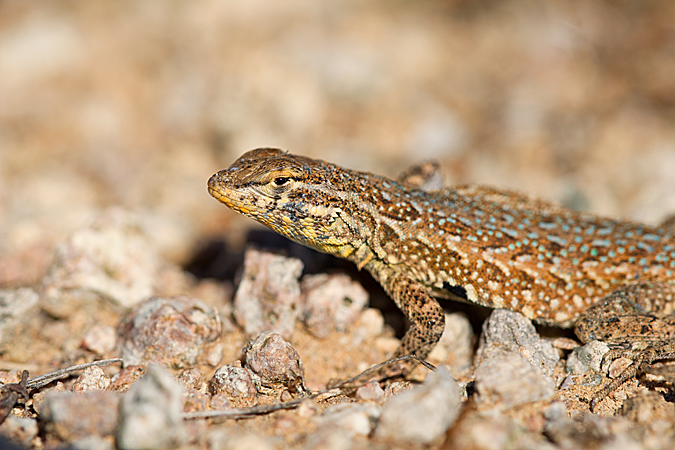
Common Side-blotched Lizard
As the sun rises in the sky, landscape opportunities dry up. Before it gets too harsh, it’s a great time to go lizard hunting. The lizards get a bit more active as it warms up too (although they do shut down for the hottest part of the day). Most of the lizards scurry away as you approach, but persistence pays off when you finally find one that you can crawl up to. I loved the texture and colors of this common side-blotched lizard. If you look closely, you can discern some of the special scales that cover its ear opening.
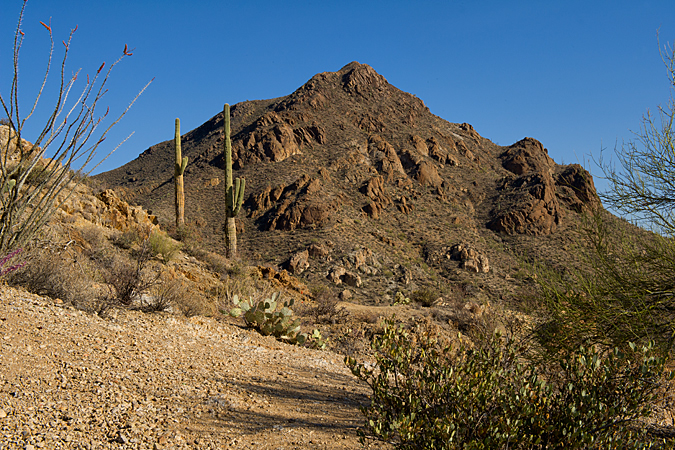
Tucson Mountains
It’s easy to think that all the best landscapes and wildlife are in the “big places” like the national parks. While these are great locales, there are smaller gems that don’t get the credit they deserve. One such place is the Tucson Mountain State Park that adjoins Saguaro National Park. The Tucson Mountains run through both the State Park and the National Park, but at this time of year with the trajectory the sun follows, some of the best views are actually from the State Park.
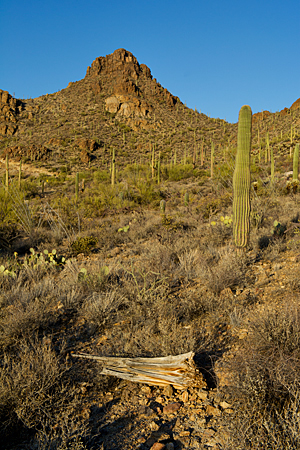
Tucson Mountains
A log in the middle of the desert? Actually when the saguaros die, they leave behind a woody skeleton that looks a lot like a tree depending on how it breaks up. I thought it made for a good foreground in front of the Tucson Mountains – again from State Park land.
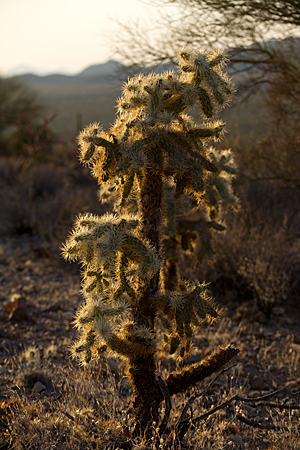
Cholla Cactus
I really can’t resist a backlit cactus. The cholla cacti especially pick up the light with their lighter colors. This is probably the sharpest cactus in the Sonoran desert. They took quite a toll on me – a month later I was still removing cactus spines. Part of the problem is that the spines don’t just stay on the plant. They drop off small pieces of the cactus or spines and when you’re crawling around photographing lizards, let’s just say that your chances of emerging unscathed aren’t so good. Of course, you can’t have a reaction when you get impaled either, or else the lizard that you’ve taken half the morning to approach is sure to run away.